The fascination of Plymouth

Devon is full of ancient towns, sweeping rural landscapes, and wild moors, and above all it is a land of wonderful coasts. Such differences, too – the intricate bays and sunlit beaches of the south, often framed in sandstone, and the wide, almost continental shores of the northern coast, with broad stretches of sand emerging from low hills or sitting under bluff cliffs of shale or sandstone. The sea roars in there, as it does in Cornwall, but on the south coast stretching from Falmouth through to Poole and beyond there is a series of deep harbours. It was here that over time the British navy came to anchor and supply its ships, and Plymouth like Portsmouth ultimately selected itself as a prime naval port, with the seemingly unlikely company of Torquay as a wide bay protected from the south-west winds.

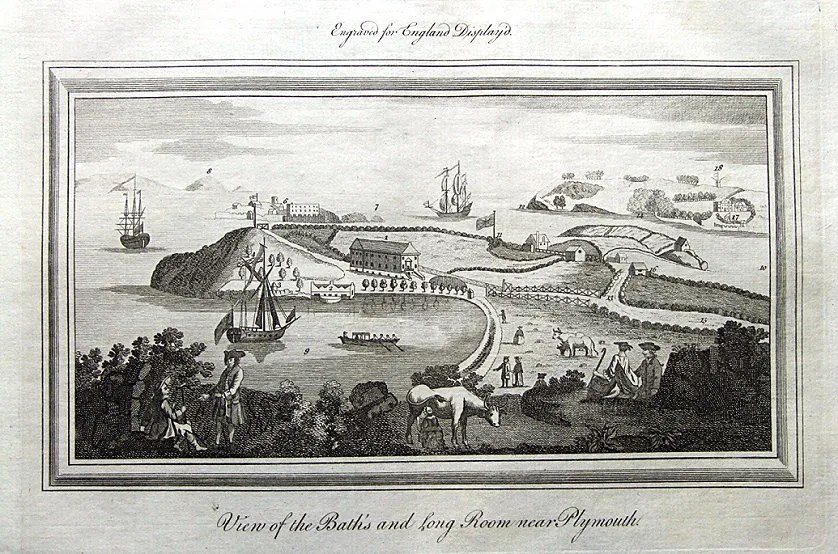
Plymouth had its old Sutton harbour, with the streets of the Barbican backing off and around it, and that is now famous as being a quay from which the Mayflower sailed. But another town grew up to the east side of the Hamoaze, the estuary of the Tamar, and to this day it is one of Britain’s most enduring naval bases, Devonport. For a great deal of its life, the Dock as it was then called was larger than its sister town, Plymouth, and for a while it was the largest town in Devon. With the presence of navy and the marines and the surrounding protection of the facilities offered by army garrisons, the three towns of Plymouth, the Dock, and Stonehouse in between them provided a thriving social life for the officer class and wealthier families in the civilian population. The attractions for both married and unattached young women included a theatre and an assembly room. Remarkably, the assembly room – known as the Long Room – still stands, and can be seen on the edge of what remains of Millbay in Stonehouse, close to what is now the continental ferry terminal. During the summer season it would be thronged with what must have been a higher proportion of uniforms per square yard than many other cities could offer, its interior dazzlingly lit with candles and stiflingly hot, with card-tables and supper complementing the exciting intimacy of the hours of dancing.

By the later years of the eighteenth century, stagecoaches as well as chaises provided a swifter connection to fashionable cities such as Bristol, Bath and London, and when Amelia visits and stays in her friend’s townhouse in Plymouth she finds shops and booksellers that would equal those of Exeter. For her, accustomed to the slower pace of rural society, it is the town that demands and absorbs her attention, while the summer encampment of the Devon militia on the downs above Plymouth has incidentally a greater influence on her life than she would ever have imagined…

Plymouth and the Dock form the setting for much of the second novel in the Wentworth Family Saga series, Heir to the Manor, which also involves events in Brittany and the manor of Kergohan.

Looking for…Kergohan

I wrote a while ago about how I started creative writing with some stories for children, largely because we had a child of our own, and I could envisage her face and eyes as she was listening to the story, and the kinds of question she would ask, and try and build that into what I wrote as much as possible. There is a gentle progression with children’s stories which is very attractive, and in general kids seem to like things to add up, although they are happy to go along with all kinds of invention. Yet there is something about a children’s story which means that you must not go too fast, because they will sense the jump, and feel short-changed. At least, that’s how I found it was.

But none of that explains Kergohan. How I found Kergohan the place I have explained in a previous post, but why I should be looking for a Kergohan is another matter. It’s fair to say that there are things you find that you didn’t know you were looking for, but also true that some things have been with you a long time without you being aware of it. Perhaps those two ideas are different sides of the same coin. But what I did know was that I began to think back to my parents again, and to this background picture of a patient author sitting in the living-room with a clip-file on her lap and writing out in long-hand, preferably on recycled paper from my father’s old press-releases.

It was evident that I felt nostalgic for that atmosphere of fiction, and so I began to form the plan of writing a novel as a tribute to her and to all those years of her fiction, from when I was small boy until well after I was married. Any proper tribute would have to be a romantic novel, and almost certainly an historical romance. My mother was infatuated with the regency period, the elegance of it and the wit, but she also wrote novels set in the later eighteenth century, the Georgian era. I set about reading all of her books again and put that alongside reading all of Jane Austen again too, hardly a penance! It was great fun but it was not intended to land me in the middle of a plot, so I set out to think around and back again to come up with that.

The home counties and the regency spa town of Bath were very much my mother’s stamping ground, although on one occasion she ventured north to where she grew up, in the story about Luddites and mills with the title The Master of Liversedge. In other words, she followed that old adage of writing about what you know best and the places to which you have access. For me, that would mean the west country, but I was also by now relatively familiar with Brittany, because it was across the water from us in Devon, and an obvious choice for our holidays.

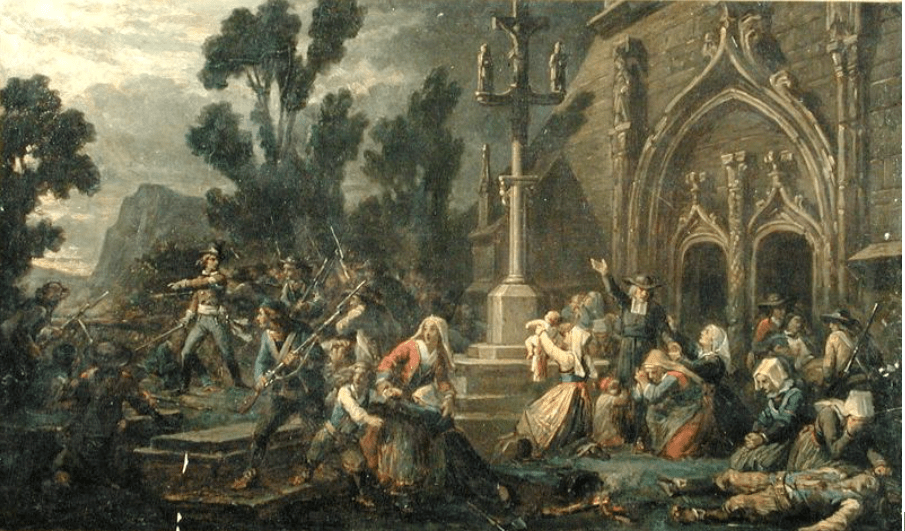
What I realised was that England was involved with the Bretons once more in the 1790s, as it had been off and on since the migration of Britons to the north-western region of France in the early centuries of the Christian era. So gradually it became clear to me that there was scope here for an adventure and romance, and that I could widen the story by having a hero who was half English and half Breton, the son of parents who had themselves met – romantically – in Canada during the earlier conflict between the French and the British. He would be caught between the two places, England and Brittany, and have to resolve issues in both while voyaging under cover to become involved in the rebellion in the west of France against the new, regicidal regime of the Republic.

And if that’s a mouthful of history, let me add that he left behind in Devon the young woman who was in love with him to encounter again in Brittany the woman he thought he had loved when she was a girl… and the boy who believes he is his son. They needed a place to live in, and that would be Kergohan.

Why do I write?


Why do I write? What made you want to be a writer? Well, I suppose that I have always written for a living, publishing what people would call non-fiction as part of my work. It began to be something of a trade, turning out page after page to order over time, week by week, and year by year. Not always drudgery, by any means, but undoubtedly something you did whether you felt like it or not, whether today is just the right day, or merely the next day in a long schedule.

But in my kind of writing, there were no characters, and for the most part it was factual. You were, in that respect, alone with yourself, without the company of people who might disagree, or do something you had not anticipated, speak or keep silent when they felt like it. There’s nothing wrong with that – it’s just different.

So you don’t know what you are missing in many respects when you write non-fiction. I would make an exception for biographies, I suppose, although I’m not sure what it would be like living with Horatio Nelson or Florence Nightingale, whether you would get up in the morning with them, see through their eyes. With imaginative biography, or the kind of dramatized history that Hilary Mantel has created, it must be exhilarating and perhaps at times haunting to be that close to the creak of floorboards under real feet.

In my case, I was nagged into fiction by a strange calling, increasingly distracted from what I was doing by the lure of telling a story, as if that call came through to me at long last. So – and this was one thing that I brought from my non-fiction writing – I thought of a readership. The first question was, even before the story had come into being, if I was to write who would be the readers?

Strange as it may be to say it, it was Tolkien’s The Hobbit that came to the rescue. I made the mistake of going to the cinema to watch the first of the series of films, hoping for the magic and entrancement of the book, and came out reeling. True, I do get deafened, and slightly sick and dizzy, from the Dolby stereo sound-system rumbling through my head and even my body. But that was not the problem. I was horrified by how a children’s story with little violence in it and plenty of mystery could be turned into something so furious.

That was the prompt. I made up my mind that I would write an adventure story that did not dip its cup into the deep beaker of aggression, and that I would open it up to children from a relatively early age to rather later, from a child listening to an adult voice to a young reader forming her own voice in her head. It was a story primarily for a girl, because I had my own daughter in mind, and it involved a dragon, or what she hoped and thought would be a dragon. And then there were other stories… one about some mice that didn’t spill the water in a cat’s bowl, and another about a sheepdog that got it all wrong.

You may well ask ‘How does that lead into Kergohan?’ That is a very good question, but to answer it properly will require a separate posting all to itself.

Kergohan

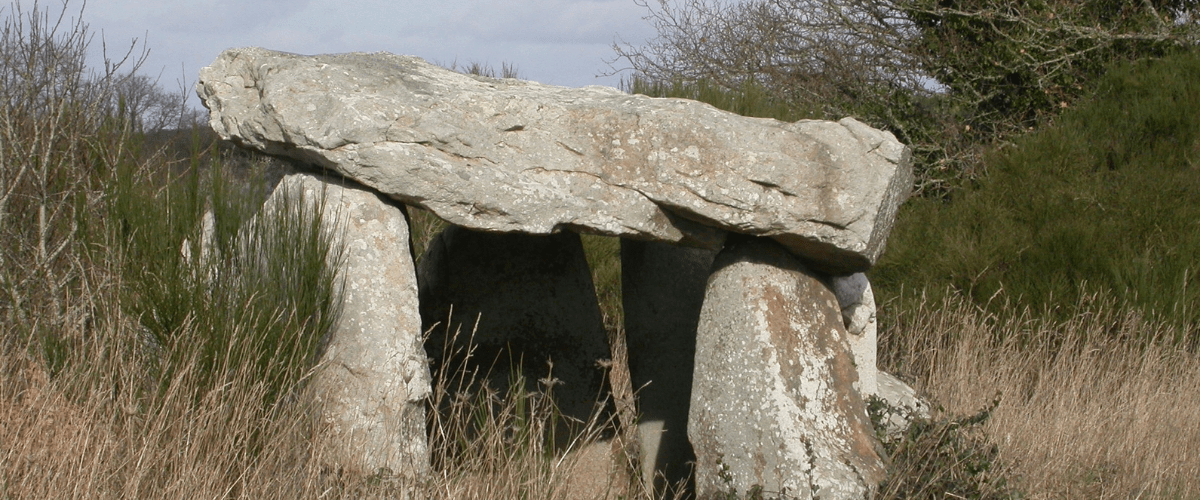
I first came across Kergohan without knowing it. We were on our way down to the coast, coming south through the Landes de Lanvaux, the long strip of forest that stands on a low range of hills in central Brittany. The descent takes you through beautiful woodland, deep shade in the dappled sunlight, with massive stones standing alongside the road as it twists down into the open fields. It was high summer, and the sunlight weighed on the flat fields that opened out away from the Landes. It was somehow the right place, empty and yet full of all the means for life, with that sense which pervades Morbihan that the warmth belongs here, that the colder lands of the Channel lie at your back, beyond the Landes and over the Black Mountains to the north, where the heather catches the mist like dew on the craggy Monts d’Arrée.

Continue reading “Kergohan”