Something odd in the drawing-room

For a very long time, I have always thought there was something slightly strange about the contemporary appeal of Jane Austen’s novels. For all the silent reading that goes on undetected, there are the many television versions and films, and a degree of comforting satisfaction in the consumption of them for which it would be hard to find a parallel. What is odd is twofold: firstly, that Austen is writing for the most part about the gentry rather than the peerage, and secondly that the novels are unquestionably seen in the twentieth century as a kind of endorsement of middle-class lives and feelings.

To be able to love Jane Austen’s writing today, through print or the audio-visual, is to be able to seal oneself off from the harsher and more tawdry aspects of life. To be sure, literature of this kind, as it developed away from Samuel Richardson’s novels, might glance or stare relentlessly with dismay at the fall from grace that could happen to young gentlewomen at the instigation of scoundrels. But there can be no doubt where the reader’s feet stand, or where their posterior is seated, which is in some kind of security from this catastrophe.

Romance in itself in the novels is anodyne, after many tears, and for the young women it looks across or up a little: but it is neither middle class, nor upper class, precisely. Mouths may water over Fitzgerald Darcy, yet there is no apparent title there, despite his aunt, and Bingley is suspected by modern critical thinking of being a gentrified product, of unknown origin. Peers are really a class apart (Duke, Marquis, Earl, Viscount and Baron, as Jennifer Kloester so ably details), and in that respect it is intriguing to speculate on what the appeal of Austen’s novels to the Prince Regent may have been. He was undoubtedly looking down, since his own tastes and patronage were elevated far above the quiet, rural life that Austen favoured.

Yet it is clear that the lives of the gentry, and their aspirations as expressed in the mothers and at times the daughters, have somehow been translated into bourgeois currency which can thrive in modern society. The actual middle classes of the Regency and beyond do not provide much symbolic stimulation of the same kind, certainly not in romantic fiction. Earning a living – rather than having one as a clergyman, who would participate according to his choice in the lives of the gentry – was no basis for captivating romance.

If that strange translation in itself is enigmatic, then it becomes more puzzling when placed against the appeal of the novels of Georgette Heyer. Heyer’s taste is undoubtedly for the peerage, and her willingness to disport with Dukes is the forerunner of the veritable plague of those with that highest of peerage titles across contemporary regency romance. Her heroes are quite evidently a class apart, and will express contempt for those beneath them, or for the ‘vulgar’ in any form, as those around him observe of the saturnine and supposedly ‘satanic’ Duke of Avon.

There is something distinctly different about the appeal of these novels. My sense is that it is rooted in the lack of apology in the conduct, manners and attitudes of the class of heroes in particular, although a good number of the women bear the same mark. How attractive and amusing it must be to be classified as one who can look down on others. While there may be social mobility involved – A Civil Contract has that explicit theme – it is driven by an unashamedly acknowledged need to shore up the aristocratic finances. Heyer’s favoured class is dicing with debt in many cases, which makes the maintenance of their glamour and elegance all the more exciting. A contemporary society of middle-class readers can enjoy a day out in a virtual world, while accepting the fragility of something so witty, beautiful and spoilt.

Which all says a lot about impermanence. The late Georgian and Regency periods straddled the earthquake of the French revolution. In and after the first World War society was shaken by another class revolution, after which the sardonic and increasingly reckless confidence of the English country house and its offspring began to fall apart. The characters remain fascinating performers from a time that escapes the tedious grasp of the everyday – or, as Heyer has it, ‘old shades’, whose loss we can ultimately endure.

CHARACTERS OF THE SAGA

It is all too easy to drift away from a saga, particularly if you’ve had to wait a long time for the next volume to appear. Now that this large story is ready for a read-through, that might be less of a problem. But life intervenes. You drop the book, and it is some time before you pick it up again.

A saga inevitably has many characters, so a refresher on them may be a helpful thing to have.

So here they are, as you meet them, from the first book of the saga, The Baron Returns:

In Devon:  Sempronie Wentworth, widowed;  Justin, her eldest child;  Amelia (Amélie), her daughter;  Arabella Wollaston, Amelia’s friend;  Sir Francis Wollaston, her father;  Captain Yeo, naval officer and family friend;  Grace, Arabella’s maid;  Andrew, Arabella’s groom;

In Brittany:  Gilles, a young orphan;  Babette, who adopted him;  Grosjean and Yaelle, their friends;  Laurent Guèvremont, wealthy cousin to Sempronie;  Joséphine, his daughter;  Le Guinec, Guèvremont’s steward;  Captain Nicolas Leroux, French Republican army;  Lieutenant Vernier, his subordinate;  Eugene Picaud, Justin’s friend.

People, and places. This saga stretches from Devon to Brittany, and ultimately to London and Brighton, and to a battlefield near the Rhine. But most of the action is in Devon and Brittany.

At the heart of it are the two manors: Chittesleigh in Devon, and Kergohan in Brittany. Although you won’t find them on any map, Chittesleigh is situated to the north of Dartmoor, in the region of Hatherleigh and Okehampton, while Kergohan is in central Brittany, some way above the large town of Auray.

Plymouth, London – the village of Hampstead, and streets near the Thames – and Brighton need no special introduction here. Plymouth Dock is now Devonport, in the western part of the city.

Kergohan, situated in central Brittany, should be relatively close to the towns of Pontivy and Auray (with its harbour at Saint Goustan), and lie on the southern edge of the forests of the landes. Close by to Kergohan are the villages of Brandivy and Plumergat.

The invading force of French royalist émigrés was landed in June 1795 from a British fleet in the bay of Quiberon, in southern Brittany, on the shore of which lies the village of Carnac.

Further characters from the three later books of the saga:

In England:  Colonel George North, friend to Justin and Amelia; Caroline North, his sister;  Drusilla Marriott, their friend;  Lieutenant Jowan Tregothen, a militia officer;  Thirza Farley, an actress;   Coline, alias for Marie-Rose Heaume, a British spy;  Loic, Coline’s runner;  Major Francis Houghton, Royal Marine officer;  vicomte de Biel-Santonge, Eugene’s father;  Dick Courtenay, a London host;  Alphonse, a young émigré;  Charles Hoare, a militia ensign;

In Brittany:  Daniel Galouane, steward of Kergohan;  Héloïse Argoubet, his niece;  Bernard Sarzou, butler to Guèvremont;  Robert Harker, American sea captain;  Raoul Lafargue, slave overseer; Clémence de Moire, friend to Joséphine Guèvremont;  Mael Sarzou, former steward of Kergohan;  Jeanne Cariou, Gilles’s aunt;  Katell Floch, Héloïse’s friend;  Roparzh Floch, her brother. 

Saba, the mother of Héloïse and sister of Daniel, was taken as a mistress by Octave Argoubet on the Galouane plantation in Saint-Domingue, and died on the plantation. Daniel, Saba, and Héloïse were freed by Argoubet.

In any historical fiction there are historical figures, and these few appear briefly as speaking characters in the novels. Georges Cadoudal, the renowned Breton leader, who brought the Chouan army to Quiberon; Jean Rohu, a tenacious and daring lieutenant of his; William Windham, a Secretary at War under the British Prime Minister William Pitt;  Anna Laetitia Barbauld, abolitionist and radical and influential poet;  Banastre Tarleton, officer and supporter of the slave trade;  George Hibbert, a spokesman for the slave trade;  Abbé Carron, active in Jersey and then London on behalf of orphaned children;  Lord Thomas Pelham, Surveyor-General of Customs of London.

Philippe d’Auvergne was resident in Jersey in the Channel Islands for many years on what amounted to a British pension, supervising the flow of information from Brittany and France to the British government through a network of spies.

AMBUSHED BY A SAGA

In the spirit of Kit Fielding, whose posts on the Facebook page of the Devon Book Club I admire, I am going to talk here about writing rather than just publication. I am looking at a five-year period in the creation of what is conventionally known as a ‘saga’, which will conclude in January 2025. Four connected novels over that time, running through the spring and summer of successive years, 1795 and 1796.

Why a ‘saga’? Well, because that was what the publisher decided, and it may be there is no other term for it. Since the expansion of Kindle Unlimited, serial reading has become something of a norm, as it lends itself to binge reading, which sells books well to new readers. A series can take several forms: familiar characters in different scenarios, different episodes in an extended story, and many other variations.

Mine proved to be not like that… I grew up alongside a regency romance writer, my mother Alice Chetwynd Ley (you can see her life and writings at alicechetwyndley.co.uk), and my first novel was meant to be much the same as hers. But it was different, with the outside world impinging more, men separated from women by war, and a post-Brexit linkage between Devon and Brittany, that historic relationship which goes back at least two thousand years – as far back as the iron-age tribes of the Dumnonii and Cornovii, names still found in the Breton regions of Dumnonée and Cornouaille.

I was also more interested in politics. My chosen period was the era of the aftershock of the execution of the French monarchy and the establishment of a Republic, acts despised by many Bretons of that time, and feared in Britain. And I was determined to be more explicit about aspects of social change and upheaval: so the abolitionist movement in England, revolt in the French slave plantations of the Caribbean, the confiscation of church and aristocratic lands in Brittany, growing signs of women’s independence of mind and will, divided loyalties in principled men.

The result was more characters. Characters spread very easily, and multiply like cells. Writers tend to slap them down, restrict their growth to fit with a core plot and the strict tropes of contemporary publishing, notably in romance. Yet characters can only serve the stories of other characters up to a certain point. After that, they demand their own space, and they may get tied up with each other: or they may well have been so, over time. By the end of the first novel, I had unfinished business in more restless characters, and in resolving that issue I found that I added more…

One novel becomes two becomes three, and what can you call that if not a saga, even if it bears no trace of the influence of Snorri Sturlson? Yet the frustration is that a saga cannot be read in one novel, and reads with some difficulty when its four parts come out over five years. So you can see why I might be rejoicing that in January the full story will be finally in view.

They say that a picture is worth a thousand words; there are only five hundred words or so here, but four covers will stand in well. The first three novels, all published by Sapere Books, are already available on Amazon; the concluding novel is on pre-order before publication on 17 January 2025:

https://getbook.at/MoonlightAtCuckmere

Pictures of the times

Professional authors find themselves divided into different camps, often classified as genres – crime and thrillers, romance, historical, fantasy – but although these may sound like the enjoyable indulgence of a chosen fancy, any fiction author of this kind will get seriously stuck into research. It may even be the kind of background work required that draws a writer to a genre, or puts them off trying their hand. I myself would pass up the chance to write an historical naval story because I could not face carrying around all the vital details of rigging and mechanics on a ship – and indeed, woe betide the airforce novelist who gets the calibre of fighter plane’s wing-guns wrong, or even the manufacturer of the shell-casing…

It is not, of course, all nuts and bolts. Romance may look frilly at times, but the grande dame of the historical genre, Georgette Heyer, carries a formidable reputation for her knowledge of the intricacies of costume and stylish speech; and a writer of contemporary romance may need to research breeds of dog, or the train timetable between Horsham and London, to make some relatively small thing work out well in addition to other more fundamental elements of the tale. Writers get deeply enmeshed in research, and often talk about falling
down a ‘rabbit-hole’ as they get distracted by a fascination with some initially relevant topic that will not, ultimately, add much to their novel.

The internet has certainly made home-based research far easier, since the internet has now expanded to include all kinds of sources that are deeply obscure on all kinds of subjects: reprints of hitherto unavailable pamphlets and books, archive collections containing that ever-so-vital and revealing letter, and treasure trove of all and totally unexpected kinds. A potential black hole, rather than a rabbit-hole.

But writers still often need to travel, and research on the ground is a vital part of the creation of many novels. I had spent many years on holidays in Brittany, across the water from my home county of Devon, before I turned to fiction, and my relaxing explorations over time gave me knowledge of the fields and woods, the towns and villages, the stunning coastline, and gradually the buildings and way of life of earlier times. Devon was also at hand, and in various casual jobs I travelled across the county, popping up all over the place, and poking my nose down remote lanes, crossing fields and standing in ancient barns out of the rain.

Yet whether it is research conducted from home, or trodden out on the ground, one thing is often missing, or at least not available in the form that you want it, and that is a picture of the place that interests you in the historical moment in which you have hung your story. That is self-evidently all the more probable before the age of photography, and so as a writer whose novels are set in the late eighteenth century I have found myself excited by the recent discovery of two visual sources previously unknown to me. They are both in their own way
quite astonishing.

The first came to me via the kind intervention of my wife’s mother, who looked for a book for me on the history of the Isle of Wight, where I had set some of the final scenes of my fourth novel, Moonlight at Cuckmere Haven, which concludes the Wentworth saga and which will be published in the autumn of 2024. Included in the short book were several illustrations by the artist and cartoonist Thomas Rowlandson, who had taken trips to the Island with a couple of friends, notably in the 1790s. These lively sketches and watercolours of scenes from the Island in the 1790s were peopled with soldiers and islanders, showing boats and carts and surroundings and landscapes. Wonderful!

The second source was given to me as a present by my wife, and consists of four stunning volumes of Travels in Georgian Devon by the Reverend John Swete, copiously illustrated in watercolours by the reverend gentleman himself, who took himself around the landscapes and private houses of the gentry, once again – and conveniently for me – in the 1790s.

So my eye can wander with some confidence across scenes from the precise period in which my novels are set, and feel tolerably secure and satisfied that I am allowing more recent intrusions to fade back and away as I try to envisage actions by characters, and to soak up the pace of life, the emptiness at times of the landscape, of housing and of people, the small scale of villages and even small towns.

It is a lucky chance. The Isle of Wight Heritage Service has generously given me permission to reproduce three of the drawings from the Rowlandson collection it holds, which I have done on a post on my Facebook page. They are delightful on their own account, and if you enjoy historical novels then they give a rare flavour of people and lives and boats at the very time of which you are reading. Directions are given on that Facebook post for you to be able to access the collection, with further thanks to the Heritage Service for their help and
permission. Travels in Georgian Devon is available in four volumes, edited by Margery Rowe and Todd Gray, and published by Devon Books in 1998.

To the manor born?

It’s easy enough to get the wording of this popular phrase wrong. What Shakespeare had his most famous character say was “I am native here, and to the manner born”, and indeed it must be doubted that Hamlet would have acknowledged a mere ‘manor’ rather than the palace of Elsinore! I shall come
back to that kind of difference, because it is significant; but for the moment I shall concentrate on manors, since I should recognise that I have built my Wentworth Family saga around two historic manors houses, one in Devon and the other in Brittany.

But it was not the buildings that came first. As I have indicated in other posts, I was struck by the idea of pairing Devon and Brittany because I was familiar with both regions, and warmed to them. Why not? They are beautiful; both feel as if they are surrounded by sea, and wild or balmy coasts; and both have a strange, almost archaic mixture of spreading countryside and small market towns. Each also has its cities, and wears its history on its chest and shoulders, with ancient monuments such as the stone circles and rows on Dartmoor, and the magnificent granite dolmens and alignments in Brittany. The regions are
linked: they have been so from the pre-Roman period until the many cross channel ferries and the vibrant Celtic music festivals of today.

But there is more, and it soon strikes the eye. Both have a remarkable pedigree of ancient domestic building, in stone, timber and cob in Devon, and timber and stone in Brittany: farmhouses, barns, cottages, from small to extensive, some almost unchanged and four or five hundred years old, others altered and adapted over time. I knew that if the regions were to be brought together in a story, and there were to be characters who would come to life through that story, then that would have to come about through a marriage. In the case of the Wentworth family, this was going to be the union of an English gentleman with the daughter of a Breton nobleman, and the joint inheritance for their son and heir of two manors: Chittesleigh above Dartmoor in the western part of Devon, and Kergohan below the forest in the southern part of central Brittany.

So it turned out that the hero of the Wentworth Family saga is indeed ‘to the manor born’, on both sides of the Channel, but in a period, in the 1790s, when that inheritance is disrupted and subsequently contested. The two manors are at the heart of the family’s future, and of many of those associated with them: Chittesleigh in farmland just to the north of the moor, Kergohan in mixed farmland and woods, sloping away southwards from the central, low hills of the landes.

But what would these evocative buildings look like? Each manor has a presence throughout the saga, the one in England granting a degree of continuing status to its occupants, while across the Channel the other is turned abruptly into property by means of the confiscations of the new French Republic. How would we imagine them? What kind of picture should we have in our mind’s eye?

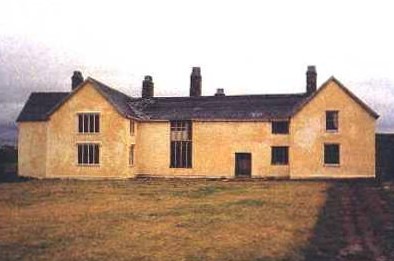
Well, not perhaps how a casual assumption might think of them. The classic Tudor mansion, even palace in England, stands up to our mind distinctively in red brick, like Hampton Court for example. But in Devon the older building materials for large bartons, or farmhouses that might be manors were timber and cob – a solid mix of straw, dung and clay. Rebuilding gradually took place in stone, often in granite in which the county abounds. Rashleigh Barton with its two projecting wings gives a great impression of a more stately farmhouse of the old medieval and Tudor school; but many more buildings were gradually rebuilt or set out like South Wood Farm pictured here or Cadhay, either of which you can visit during the summer months. Perhaps Chittesleigh was like these, but had also an adjustment to the more classical tastes of the eighteenth century in one wing, in the manner in which many houses were being
remodelled?

Rashleigh Barton, photograph by Tiberius 100

South Wood Farm

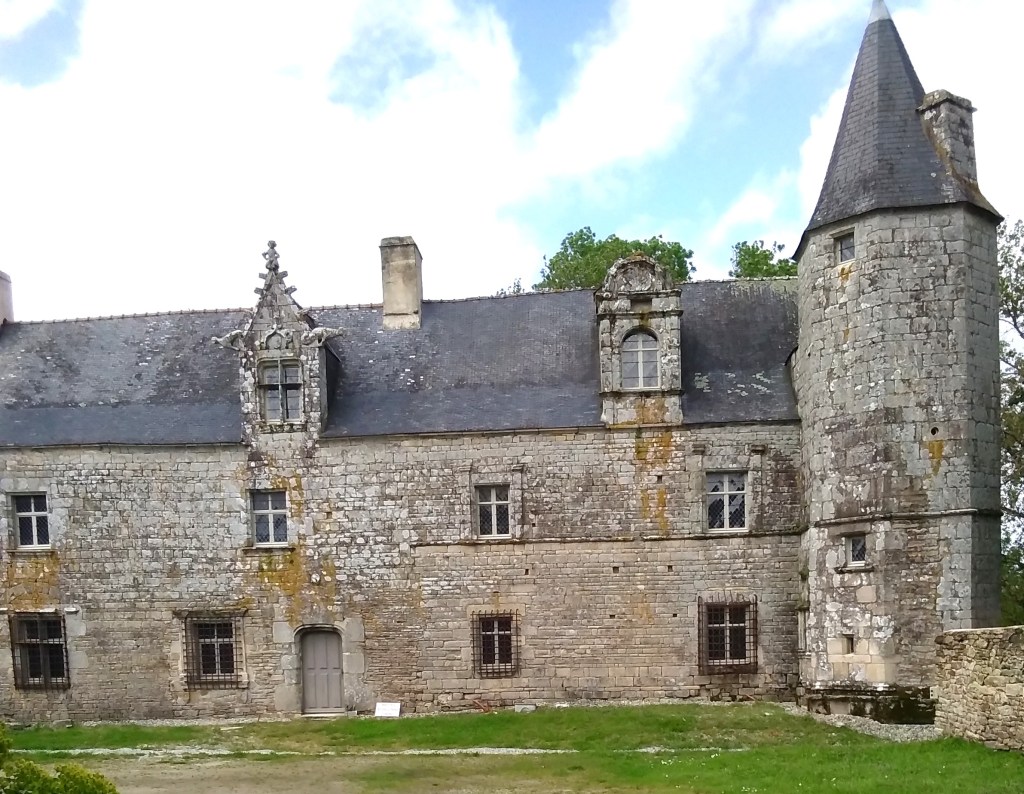
In Brittany, you can take your pick of many, many wonderful surviving medieval manors, and all you have to do is make yourself scale down in your imagination and expectations from the grandeur of the chateaux for which France is rightly famous. The rural manors are unassuming buildings, but impressive in their way and their day, perhaps more integrated with the countryside surrounding them than were the imposing chateaux. Surprisingly, many of the manors remain more or less unaltered after the small adjustments and adaptations that had been made until the period of the revolution. You can see images of two here, the manor of Kergal which is actually near Brandivy, and so close to some of the action of the later novels, and that of the Valley of Hollies, which is close to the massive chateau of Josselin.

Manoir de Kergal

Manoir du Val aux Houx

Their architecture is a time-honoured combination of rough stone and timber such as you will also find in other smaller houses in the countryside, in the villages and the small towns. Like the Devon ‘bartons’, they are versions of farmhouses which have been expanded to provide slightly finer accommodation for the gentry or lesser nobility of Brittany. Those with more ambitious taste were already building in a different style, and the relatively small, compact chateau of Trégranteur pictured here also lies just to the south of Josselin, architecturally at odd with the village which is its neighbour.

Chateau de Trégranteur

The manors of the Wentworth Family saga are a picture of the changing times, stopping short as they do of the massive influx of colonial money on both sides of the Channel into grand domestic building and neoclassicism, one that faltered and changed its pace and eventually its style in England after the end of the Napoleonic Wars, but had become subject to a life or death question of survival for a while under the new, revolutionary regime in France. The manors of Chittesleigh and Kergohan are embedded in local cultivation and management of the land, in faith in its productivity and abundance; but like the characters of the saga, they will find the terms of life changing in the expanding world of manufacture and industry.

Location, location, location

Readers have said to me that the novels in the Wentworth Family saga reveal or draw upon a strong sense of location, and I would admit that happily. With settings in Devon and Brittany there is bound to be a vibrant sense of place, and if you will forgive my loyalties I think that both regions have distinctive characteristics. I am not one for championing one region of a country against another, or relying on a region to establish timeless qualities of personality. But the prehistoric stones of Carnac in southern Brittany are an unmistakeable landmark, and the rounded moors in the south and north of Devon bookmark the countless wooded combes across the county that often feel as if no one has stepped into their leafy silence in decades.

But there is more to location than just a backdrop. I asked a group of writers recently about whether they felt that they needed to visit the places that they wrote about, and I was slightly surprised by the lack of certainty in the response. For myself, I find that I am repeatedly writing about places that I have come to know, and tracing patterns on the ground. Needless to say, the more rural the location, the less it may have changed. Here in Devon it is possible to confirm that the pattern of farms around a given area has been there since the Domesday Book, with not much else added, and the shape of small country towns has changed little over time. I like old buildings, and so for me it is a pleasant task to work out what was around in the period of my novels, the 1790s, at least in the grid of streets, removing in my mind the later built additions, peering behind rendered facades, and furtively sneaking down alleys into mews and stable-yards.

Oddly enough, even in the metropolis of London older maps reveal that the lines of roads have not changed much in the centre. One significant alteration lies in the consolidation of the embankment, but even with that affecting some sites, the old ‘stairs’ that gave access from the waterside to the warehousing on the street above can still be found. These may have had a small quay or landing-stage attached to them, and smaller boats would then offload cargo from the ships that anchored in the Pool of London right up to London Bridge. Further out, a village like Hampstead has developed greatly, but the general lines of it remain largely unchanged, with the expansion of more modern dwellings partly constrained by the extent of the Heath. These are locations for some of the dangers in the third novel, Lady at the Lodge.

While I would accept that there is something similar in the towns of central Brittany that feature in the novels, notably Pontivy with its chateau and Auray with St Goustan just across the bridge, there are scenes in all of the novels that occur inside or in the immediate vicinity of two townhouses owned by one of the leading characters, Laurent Guèvremont.

In Pontivy, the delightful chapel of St Ivy and the imposing church, the market-places and the bridge, and the chateau itself featured in Lady at the Lodge are all there on the ground and can be visited, and the old prison in Auray from The Baron Returns still exists and even opens its doors (and no doubt its cells) to visitors on certain days in the summer. Yet quite where the townhouses would be remains elusive, although there are suitable facades in suitable locations. Characters grow out of the ground and the environs, but they are warm-blooded, and insist on a life of their own. Their hopes and fears, loves and losses are the pulse of novels, and though they move across and through them they are not to be found captured in the buildings and pathways of historical research.

Yet perhaps they can be followed. Even if you cannot find the crowded Little Pig tavern from The Baron…, the old town in Quiberon has its bustling bars, and it takes very little to look out and imagine the formidable British ships of the line rolling their towering masts in the gentle swell of the sea in Quiberon Bay.

WHOSE PLOT?

When I think of plots in romantic fiction, I think of neatly crafted storylines. So, to take one shining example, a duke is accosted in the street by an urchin, whom he takes on to be his page. The page proves to be a girl not a boy, and also the disowned daughter of a count who is made to pay for his dishonesty. After making her his ward, the duke finally marries the count’s daughter. All of this can be found in These Old Shades, one of Georgette Heyer’s most brilliant and compelling historical romances, interestingly set well before the more popular Regency period. One might object that the heroine is inherently powerless, the hero seemingly infallible, but the plot hinges relatively simply on identity, in gender and rank. No matter how pretty and charming she might have been, this duke would not have married an urchin.

Our standard idea of a plot often includes a resolution which we enjoy as a solution to a puzzle, such as the right people getting it together at the end, the righting of a wrong, the solving of a crime, and so on. And – as romance bloggers have insisted in writing about what they do – one of the standard
features of a romantic plot is some kind of reversal, with the hero and heroine changing from dislike to love, much as Beatrice and Benedick in Shakespeare’s Much Ado About Nothing, one of the most eminent models for this kind of fiction; or overcoming some major obstacle to achieve their union, which has its eighteenth-century ancestor in the truly horrendous, ‘gothic’ difficulties placed in the way of Anne Radcliffe’s heroines and heroes.

In romantic fiction, these changes are now called ‘tropes’, and they are there to ensure that we get the resolution we would like. So the main thing about a plot is, quite regularly, our confidence as readers that it is heading in a certain direction – we can be sure that Tom Jones will be bound to end up with Sophia, no matter what comes along in between, in Fielding’s great novel, and even in the complex plots of nineteenth-century blockbusters something tells us quite early on that certain characters will win through, or – in other cases – that sadly or tragically they will never make it.

In general, we probably accept that the plot is substantially the author’s contrivance, and you can either agree to be made miserable by Thomas Hardy or to be cheered by Jane Austen. But in fact as readers our sense of the direction of a plot may also take in the contrivances of characters. In These Old Shades, the veiled and indeed hooded eyes of the duke from the beginning conceal the germ of a plot of his own making – one that aims to determine the identity of his young page, whom he suspects from the outset to be a young woman; to unravel the plot of her father in disowning her; and then to hatch a plot of his own, which will restore the heroine to her mother at least and bring
revenge down on her father. So ‘plotting’ is not just left to the author, but is delegated to characters, to get on with as best they may, and some characters will be shown to be expert at it, others even unaware that such cleverness can exist or be expected to have a positive outcome.

Yet there is another side to that, because in life as we know it so many plans and intentions, so much scheming and wilful inclination, and so much deception and overpowering manipulation fail to achieve the ends their initiators have in mind for them. This is as dreadfully true of military actions, such as the misconceived and poorly executed invasion at Quiberon in the summer of 1795 (in The Baron Returns), as it is of attempts made to restrict the designs of an unscrupulous rake without occasioning unintended harm to others (in Heir to the Manor).

So I would put some trust in the idea that ‘plots’ may come together from things that go completely wrong as well as things that go just about right, as I believe that Jane Austen knew very well, and I would add another thought which convinces me as a writer: it may be that we see more of characters when they are working their way through a world that never quite goes the way they
want, when the ‘plotting’ which we all do, innocently or wickedly, cannot fully be relied upon.

WHAT’S ALL THIS ABOUT A CHOUAN REBELLION?

History is depressingly full of wars, some better known, some only remembered in a particular region or by researchers. That is very much the case with many of the conflicts between France and England (latterly Great Britain) in the eighteenth century, of which some of the most relentless have almost vanished from sight. Few in Britain now know much of the wars in North America between those two nations, not just in Canada but further afield across what would now be the mid-western and north-eastern United States. All were colonial wars, and not the least of these were the bitter struggles in the Caribbean, where the French and the English (and the Spanish) fought alongside the revolts of the slaves on the plantations, notably in Saint-Domingue on the island of Haiti.

This last conflict drives Héloïse in my second novel, Heir to the Manor, to seek refuge in mainland France, even if the threat of violence follows her to Brittany where her uncle, Daniel has gained a precarious foothold. She is confronted there by the aftershock of another bitter engagement between Brittany and the new Republican government of France. This Chouan rebellion, as it is known, engulfed the northwest of France in the 1790s; there was a similar, and even more bloody rebellion to the south of the Loire and of the city of Nantes in the Vendeé, crushed with brutal force. There were terrible executions in Brittany, most of which took place just outside Auray and are remembered in these novels – notably in the first, The Baron Returns.

In the case of the Chouans, major causes of the uprising were compulsory conscription into the French army and the imposition of a priesthood determined by the revolutionary civil government in Paris. Add to this the profound shock at the execution of the King of France in 1793, keystone to the
continued existence of the ancient regime in Brittany as elsewhere. Everything seemed undermined, and the rural continuity of life made increasingly subject to the predatory influence of the wealthier bourgeoisie in the towns, who like the Tudor gentry in England gained from the confiscation of church and aristocratic lands and possessions.

There were great leaders, and poor leaders. By general agreement, Georges Cadoudal was one of the former, who lived and survived to fight another day for a long time (The Baron Returns); Jean Rohu was another (in the third novel, Lady at the Lodge). Many leaders were killed or executed by the Republicans, with limited victories sunk by serious defeats, one of the worst being the failure of
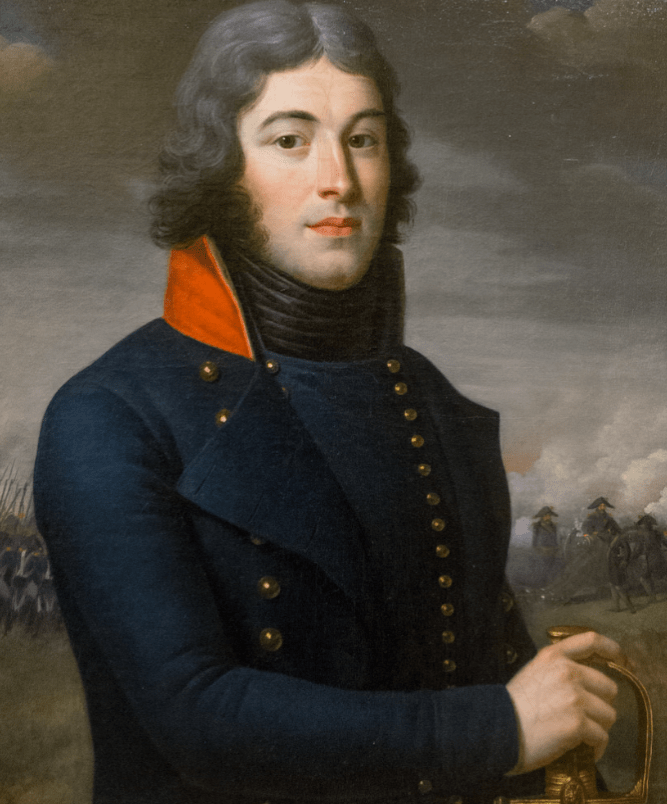
the landings at Quiberon which form a core to the story in The Baron Returns. In Brittany, the Republican army was commanded by General Lazare Hoche, who defeated the Chouans and the émigrés at Quiberon. Hoche went on to have the ambition of taking the war to the British Isles, entertaining some strange ideas about how to make that successful, which engage the attentions of
characters in Heir to the Manor and set the cat truly amongst the pigeons in Lady at the Lodge.


All of this occurred before what we think we know best – the Napoleonic Wars, with their iconic military and naval leaders, and the spectacle of the broad lands of Europe and Russia as a setting for brutal battles on a wide canvas, which may still enthuse those who can take solace and protection from the belief that, in L.P.Hartley’s words, “The past is a foreign country; they do things differently
there” (The Go-Between, 1953).

Lazare Houche

Georges Cadoudal

THE SAGA CONTINUES WITH THE THIRD NOVEL, LADY AT THE LODGE

Lady at the Lodge (published 8 December 2023) is the third novel in the Wentworth Family Saga, which is set in the final decade of the eighteenth century in England and France. These are turbulent times, and the Wentworth family is caught up in them because it is Anglo-French, and so its men and women have lives that are involved in events on both sides of the channel.

Much concerns the fate of a naïve young man, Gilles, whose mother died when he was a baby, and whose father is unknown, although two members of the wider family are suspected. The mystery remains, and in the aftermath of land confiscations his fate becomes bound up with the fate of the Breton manor of Kergohan (see my earlier posts), which may prove to be his inheritance.

Behind the turbulence lies a rebellion in Brittany, in which the British support the popular Breton uprising against the new French Republic. Gilles rashly becomes involved in the violence, and other members of the family risk their lives in saving him (the subject of the first novel, The Baron Returns). He becomes drawn into a tempestuous relationship with a young refugee called Héloïse from Saint-Domingue, the French plantation colony in the Caribbean, itself subject to a rebellion by those who have been brought there to labour as slaves. The cruelty of that world follows Héloïse across the Atlantic to her new home.

Yet the turbulence of the times does not just affect events in France. The young Amelia Wentworth in England is beginning to find her feet in society, but in Plymouth she attracts the attentions of a renegade young militia lieutenant, Jowan Tregothen, cynically on the lookout for a respectable fortune (see the earlier post on old Plymouth). She and her sister-in-law, Arabella, contrive to thwart his ambitions, but their clever and courageous plan creates a legacy of resentment, which leaves them open to the threat of revenge (the developing stories of the second novel, Heir to the Manor).

While Gilles and his beloved Héloïse learn how to adjust to the new world of the Republic, in separation from each other and at the mercy of those who do not wish them well, Amelia and Arabella walk open-eyed into the dangerous traps set for them by Tregothen…

From the rural settings of Devon and Kergohan to the bustling naval town of Plymouth in the earlier novels of the saga, the action moves in Lady at the Lodge to the narrow streets of the growing towns of Pontivy and Auray in Brittany, and to the pleasure gardens and ‘disorderly houses’ of Georgian London, the greatest city on earth.

The Baron Returns, Heir to the Manor, and Lady at the Lodge are all available as ebooks or in paperback from Sapere Books via Amazon ordering online.

Too much background? A light touch in historical novels


People ask about the background to novels, or at least some do, and in some ways it is easy to sketch in. There was a war, people were caught up in it, some were unsure of where their loyalties lay, women in particular could do little to affect the outcome of the conflict, but were threatened by the violence and desolated by the loss of loved ones. An all-too-familiar picture, which we dread being repeated, and fear for those who are subjected to its traumas.

But how much more detail do people want to know about an historical war? For my part, I care about characters who are aboard ships if I am drawn to them: I shall follow them through a storm or down below, and be absorbed in the atmosphere. But to be frank I do not share the fascination with the details and intricacies of naval life with the jargon and technical language, which sets me apart from quite a wide readership of recent decades. I remember my dad getting caught by Hornblower, and reading through the whole series by C.S.Forester, so much so that I recall the paperbacks lying there by his chair even now. I tried them out myself, but like those of a later author, I could never really say I was caught by them in the same way as my father was, and with him countless others.

So it can be with history. I have read some novels where the author was so keen on imparting an authentic background that the historical detail became a protagonist, and it seemed that everything had to stop for a while until the next piece of information was communicated. Yet, on the contrary, I have found myself irritated by daft evocations of historical periods that might as well have been set in Bromley or Milton Keynes, Burbank or Dallas, or by characters who jumped like frogs from beauty patches and Georgian duelling to Victorian bustles, stovepipe hats and London fogs.

Of course, some fictional characters will have an interest in current affairs, and perhaps even a close involvement. This will be true of the late eighteenth century if they are gentlemen, officers, landed gentry, and justices of the peace, and women in urban or rural life may well share those interests, or advance forthright and independent views. All may be opinionated, captious and contentious, holding forth or contradicting those who annoy them. Some will have strong principles, which may be contested, and many will be prepared to advance causes such as patriotism, and not a small number show to lasting commitment to abolitionism or suffrage. After all, these reforms were ultimately made in Britain because many people had committed to them over a very long time.

It is also the small, incidental details of everyday life that may demand to be seen, as a painter may carefully select objects to accompany a sitter, regarding costume and dress too as indicative of wealth and standing. Yet in an historical novel, the period and its defining actions, distressing or invigorating, distant or local, will create and shape the feelings and aims of its characters to a greater or lesser degree, and lend a distinctive quality to the story. It is as if we could say, when reading it, that these things might not have happened in quite this way in a different period – and so sense that, like these characters, we ourselves carry the pathos of our lives, which will seem so moving and so strange to our children and their children’s children.