
It’s easy enough to get the wording of this popular phrase wrong. What Shakespeare had his most famous character say was “I am native here, and to the manner born”, and indeed it must be doubted that Hamlet would have acknowledged a mere ‘manor’ rather than the palace of Elsinore! I shall come
back to that kind of difference, because it is significant; but for the moment I shall concentrate on manors, since I should recognise that I have built my Wentworth Family saga around two historic manors houses, one in Devon and the other in Brittany.
But it was not the buildings that came first. As I have indicated in other posts, I was struck by the idea of pairing Devon and Brittany because I was familiar with both regions, and warmed to them. Why not? They are beautiful; both feel as if they are surrounded by sea, and wild or balmy coasts; and both have a strange, almost archaic mixture of spreading countryside and small market towns. Each also has its cities, and wears its history on its chest and shoulders, with ancient monuments such as the stone circles and rows on Dartmoor, and the magnificent granite dolmens and alignments in Brittany. The regions are
linked: they have been so from the pre-Roman period until the many cross channel ferries and the vibrant Celtic music festivals of today.
But there is more, and it soon strikes the eye. Both have a remarkable pedigree of ancient domestic building, in stone, timber and cob in Devon, and timber and stone in Brittany: farmhouses, barns, cottages, from small to extensive, some almost unchanged and four or five hundred years old, others altered and adapted over time. I knew that if the regions were to be brought together in a story, and there were to be characters who would come to life through that story, then that would have to come about through a marriage. In the case of the Wentworth family, this was going to be the union of an English gentleman with the daughter of a Breton nobleman, and the joint inheritance for their son and heir of two manors: Chittesleigh above Dartmoor in the western part of Devon, and Kergohan below the forest in the southern part of central Brittany.
So it turned out that the hero of the Wentworth Family saga is indeed ‘to the manor born’, on both sides of the Channel, but in a period, in the 1790s, when that inheritance is disrupted and subsequently contested. The two manors are at the heart of the family’s future, and of many of those associated with them: Chittesleigh in farmland just to the north of the moor, Kergohan in mixed farmland and woods, sloping away southwards from the central, low hills of the landes.
But what would these evocative buildings look like? Each manor has a presence throughout the saga, the one in England granting a degree of continuing status to its occupants, while across the Channel the other is turned abruptly into property by means of the confiscations of the new French Republic. How would we imagine them? What kind of picture should we have in our mind’s eye?
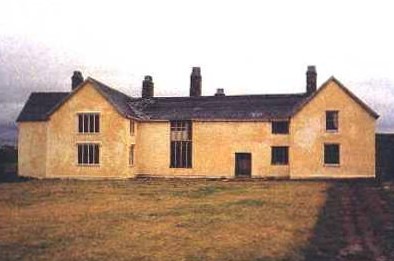
Well, not perhaps how a casual assumption might think of them. The classic Tudor mansion, even palace in England, stands up to our mind distinctively in red brick, like Hampton Court for example. But in Devon the older building materials for large bartons, or farmhouses that might be manors were timber and cob – a solid mix of straw, dung and clay. Rebuilding gradually took place in stone, often in granite in which the county abounds. Rashleigh Barton with its two projecting wings gives a great impression of a more stately farmhouse of the old medieval and Tudor school; but many more buildings were gradually rebuilt or set out like South Wood Farm pictured here or Cadhay, either of which you can visit during the summer months. Perhaps Chittesleigh was like these, but had also an adjustment to the more classical tastes of the eighteenth century in one wing, in the manner in which many houses were being
remodelled?
Rashleigh Barton, photograph by Tiberius 100

South Wood Farm
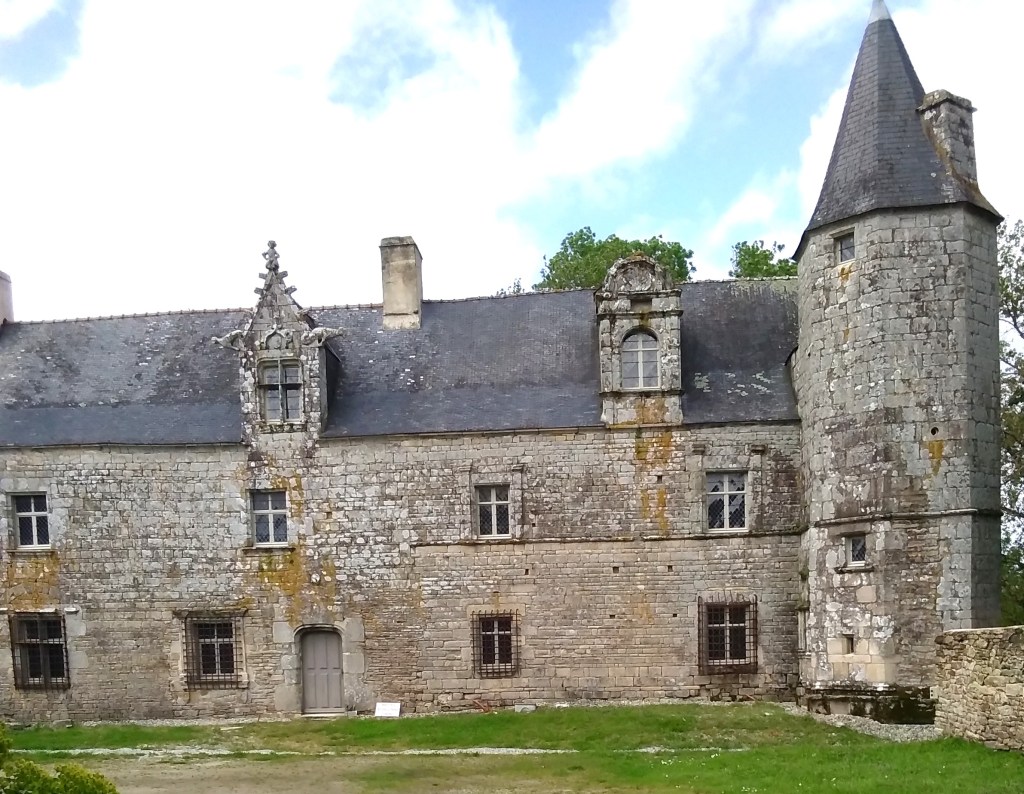
In Brittany, you can take your pick of many, many wonderful surviving medieval manors, and all you have to do is make yourself scale down in your imagination and expectations from the grandeur of the chateaux for which France is rightly famous. The rural manors are unassuming buildings, but impressive in their way and their day, perhaps more integrated with the countryside surrounding them than were the imposing chateaux. Surprisingly, many of the manors remain more or less unaltered after the small adjustments and adaptations that had been made until the period of the revolution. You can see images of two here, the manor of Kergal which is actually near Brandivy, and so close to some of the action of the later novels, and that of the Valley of Hollies, which is close to the massive chateau of Josselin.
Manoir de Kergal


Manoir du Val aux Houx
Their architecture is a time-honoured combination of rough stone and timber such as you will also find in other smaller houses in the countryside, in the villages and the small towns. Like the Devon ‘bartons’, they are versions of farmhouses which have been expanded to provide slightly finer accommodation for the gentry or lesser nobility of Brittany. Those with more ambitious taste were already building in a different style, and the relatively small, compact chateau of Trégranteur pictured here also lies just to the south of Josselin, architecturally at odd with the village which is its neighbour.

Chateau de Trégranteur
The manors of the Wentworth Family saga are a picture of the changing times, stopping short as they do of the massive influx of colonial money on both sides of the Channel into grand domestic building and neoclassicism, one that faltered and changed its pace and eventually its style in England after the end of the Napoleonic Wars, but had become subject to a life or death question of survival for a while under the new, revolutionary regime in France. The manors of Chittesleigh and Kergohan are embedded in local cultivation and management of the land, in faith in its productivity and abundance; but like the characters of the saga, they will find the terms of life changing in the expanding world of manufacture and industry.
 Graham Ley