
History is depressingly full of wars, some better known, some only remembered in a particular region or by researchers. That is very much the case with many of the conflicts between France and England (latterly Great Britain) in the eighteenth century, of which some of the most relentless have almost vanished from sight. Few in Britain now know much of the wars in North America between those two nations, not just in Canada but further afield across what would now be the mid-western and north-eastern United States. All were colonial wars, and not the least of these were the bitter struggles in the Caribbean, where the French and the English (and the Spanish) fought alongside the revolts of the slaves on the plantations, notably in Saint-Domingue on the island of Haiti.
This last conflict drives Héloïse in my second novel, Heir to the Manor, to seek refuge in mainland France, even if the threat of violence follows her to Brittany where her uncle, Daniel has gained a precarious foothold. She is confronted there by the aftershock of another bitter engagement between Brittany and the new Republican government of France. This Chouan rebellion, as it is known, engulfed the northwest of France in the 1790s; there was a similar, and even more bloody rebellion to the south of the Loire and of the city of Nantes in the Vendeé, crushed with brutal force. There were terrible executions in Brittany, most of which took place just outside Auray and are remembered in these novels – notably in the first, The Baron Returns.
In the case of the Chouans, major causes of the uprising were compulsory conscription into the French army and the imposition of a priesthood determined by the revolutionary civil government in Paris. Add to this the profound shock at the execution of the King of France in 1793, keystone to the
continued existence of the ancient regime in Brittany as elsewhere. Everything seemed undermined, and the rural continuity of life made increasingly subject to the predatory influence of the wealthier bourgeoisie in the towns, who like the Tudor gentry in England gained from the confiscation of church and aristocratic lands and possessions.
There were great leaders, and poor leaders. By general agreement, Georges Cadoudal was one of the former, who lived and survived to fight another day for a long time (The Baron Returns); Jean Rohu was another (in the third novel, Lady at the Lodge). Many leaders were killed or executed by the Republicans, with limited victories sunk by serious defeats, one of the worst being the failure of
the landings at Quiberon which form a core to the story in The Baron Returns. In Brittany, the Republican army was commanded by General Lazare Hoche, who defeated the Chouans and the émigrés at Quiberon. Hoche went on to have the ambition of taking the war to the British Isles, entertaining some strange ideas about how to make that successful, which engage the attentions of
characters in Heir to the Manor and set the cat truly amongst the pigeons in Lady at the Lodge.
All of this occurred before what we think we know best – the Napoleonic Wars, with their iconic military and naval leaders, and the spectacle of the broad lands of Europe and Russia as a setting for brutal battles on a wide canvas, which may still enthuse those who can take solace and protection from the belief that, in L.P.Hartley’s words, “The past is a foreign country; they do things differently
there” (The Go-Between, 1953).
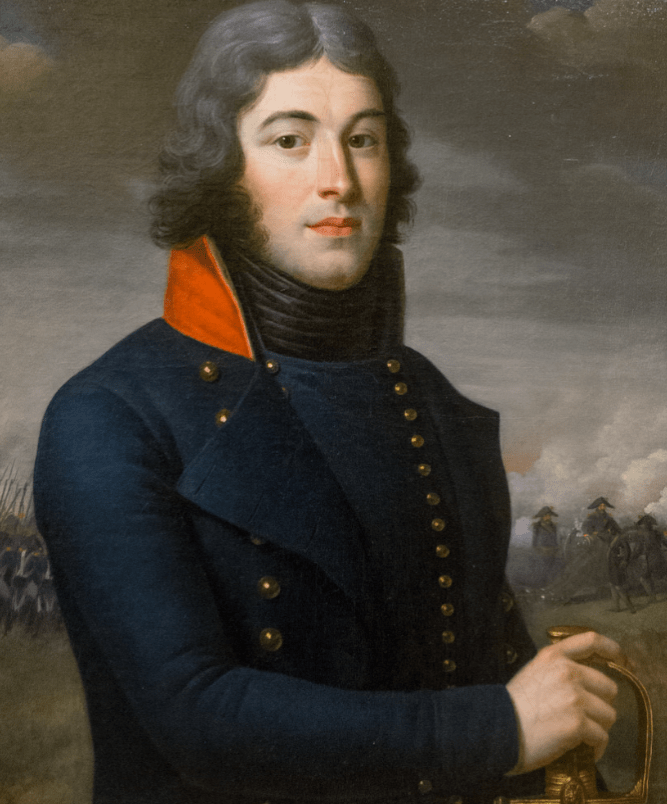
Lazare Houche

Georges Cadoudal
 Graham Ley